Products


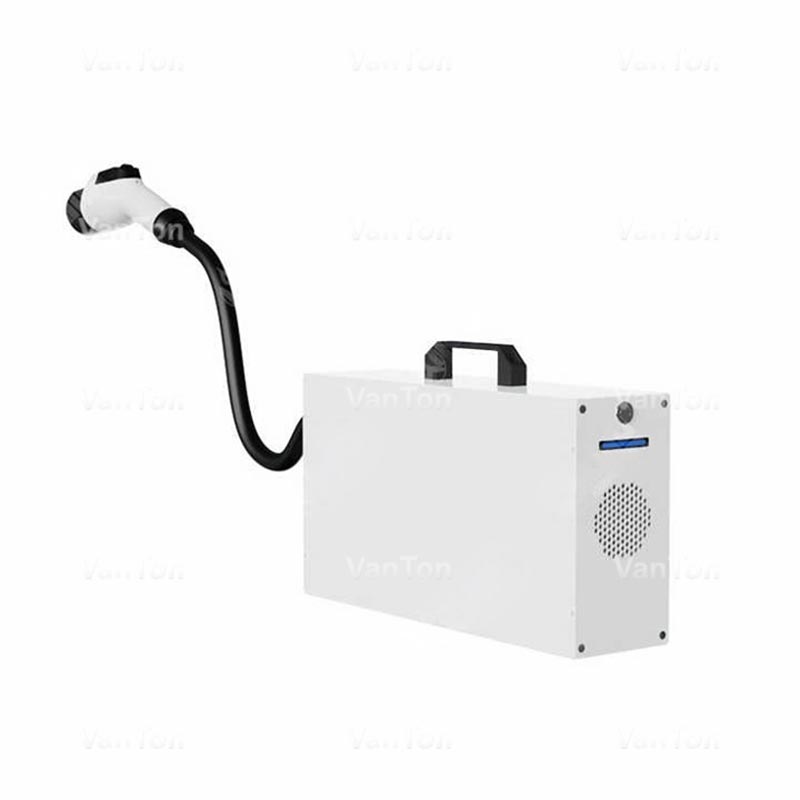
7KW High-power Smart Mobile DC EV charger with CCS Plug
VanTon, as a professional EV charging equipment supplier from China, presents the 7KW High-power Smart Mobile DC EV charger with CCS Plug, a truly portable direct‑current fast charger that plugs into any standard household AC socket (110‑250 V) and delivers up to 7 kW directly to the vehicle battery. Unlike bulky fixed stations, this unit weighs under 10 kg, fits in a carry‑case, and requires zero installation, making it the ideal companion for road trips, service fleets, and emergency backup.
This high-performance VanTon 7KW High-power Smart Mobile DC EV charger with CCS Plug is a self‑contained, portable DC fast charger that converts single‑phase AC to regulated DC output, bypassing the vehicle’s onboard charger . With a wide 200‑1000 V output and CCS1/CCS2 plug options, this 7KW Mobile Ultra-Fast DC Charging Stations for EVs supports most passenger EVs. Its compact dimensions and IP54 rating allow safe use indoors and outdoors, while OCPP 1.6/2.0 communication enables smart scheduling and remote monitoring.


What does this 7KW Portable DC EV charger Do?
This 7KW High-power Smart Mobile DC EV charger with CCS Plug serves as a go‑anywhere fast‑charging tool. It delivers 7 kWh per hour, enough to add 40‑50 km of range in one hour for a typical EV. It is especially valuable for scenarios where fixed charging infrastructure is unavailable, unreliable, or cost‑prohibitive. The unit includes full protections (over/under voltage, overcurrent, short‑circuit, leakage, etc.) and operates from ‑20 °C to 50 °C, ensuring consistent performance across seasons.
Product Features
True portability
No fixed mounting required; simply plug into a wall socket and connect to the vehicle. Weighs under 10 kg and includes a carrying handle.
High‑efficiency DC conversion
The charger bypasses the vehicle’s OBC, eliminating conversion losses inside the car and reducing battery heating during charging.
Smart connectivity
It built‑in 4G (optional) and Ethernet with OCPP 1.6/2.0 support, enabling remote start/stop, billing integration, and firmware updates.
Universal voltage input
It accepts AC 110‑250 V, 16 A or 32 A, making it compatible with both North American (120 V) and European/Chinese (220‑240 V) household outlets.
Interchangeable plugs
It's available with CCS1, CCS2, GB/T, or CHAdeMO connectors (CCS plug as standard), and the 3‑meter cable can be customised.
Comprehensive safety
IP54 enclosure, leakage detection, over‑temperature cut‑off, and insulation monitoring ensure safe operation in diverse environments.
Applications
Roadside emergency: keep the 7KW High-power Smart Mobile DC EV charger in the boot for unexpected range anxiety on long journeys where public chargers are scarce.
Fleet operations: service vans and mobile repair units can charge stranded EVs or top up fleet vehicles at remote depots without fixed chargers.
Residential flexibility: apartment dwellers without dedicated wallboxes can use this portable unit with a standard outlet for overnight charging.
Temporary events: outdoor exhibitions, pop‑up stores, or construction sites can offer EV charging without permanent electrical work.
Dealership and workshop: useful for testing and preconditioning EVs before delivery or service without installing expensive fixed DC chargers.
Difference vs. 7 kW AC Portable Charger
Although both chargers share the same 7 kW power rating, they operate on fundamentally different principles. The conventional AC portable charger outputs alternating current, which must pass through the vehicle’s onboard charger (OBC) to be converted into DC before it can enter the battery. This internal conversion generates heat and is limited by the OBC’s maximum capacity – often less than 7 kW in many older or entry‑level EVs. In contrast, the VanTon 7KW Portable DC Fast Charger for Electric Vehicle outputs direct current directly, completely bypassing the OBC. The conversion from AC to DC happens inside the external unit, where advanced power electronics achieve higher efficiency and produce less heat inside the car, preserving battery health.
Another key difference lies in charging speed and reliability. With the AC charger, the actual charging power depends on the vehicle’s OBC rating; if the OBC is only 3.3 kW, you will never get 7 kW. The DC portable charger, however, delivers its full 7 kW regardless of the vehicle’s OBC, as long as the DC inlet supports the voltage range. This makes it especially useful for EVs with weak or faulty OBCs, or for future‑proofing against newer models with higher acceptance rates.
Portability and installation also differ. Both are technically portable, but the AC unit is simpler and lighter because it lacks the bulky AC‑DC converter. The DC version, while slightly heavier, offers far greater versatility: it can charge any EV with a CCS, GB/T, or CHAdeMO inlet, whereas the AC charger only works with vehicles that have a Type 2 or NACS AC port – and many modern EVs are moving toward DC‑only fast charging. Furthermore, the DC unit’s smart communication (OCPP) enables remote monitoring and billing, features rarely found in basic AC portable chargers.
Why Choose VanTon
1. VanTon brings over 12 years of dedicated EVSE manufacturing experience, with a 50,000 m² state‑of‑the‑art factory housing precision mold, CNC, plastic molding, metal stamping, and full assembly lines. Our annual production capacity exceeds 2 million charging connection devices and 100,000 charging piles, ensuring rapid delivery even for bulk orders.
2. We hold an extensive portfolio of international certifications, including CE, TUV, UL, CSA, BS, SAA, PSE, CCC, and NF, covering all major markets. Our quality management systems are certified to IATF 16949, ISO 9001, ISO 14001, ISO 45001, and SA8000, demonstrating our commitment to quality, environment, occupational health, and social responsibility.
3. Our R&D team continuously innovates in high‑power and wireless charging technologies, and we are a drafting unit for global high‑power charging interface standards. This technical edge ensures that our 7KW High-power Smart Mobile DC EV charger is built with the latest efficient conversion topologies and robust thermal management.
4. We offer flexible customisation – cable lengths, connector types (CCS1/CCS2/GB/T/CHAdeMO), colours, and even OCPP configurations – to match your specific project requirements. With a low MOQ of just 1 piece and competitive pricing, we make it easy for any business to enter or expand in the EV charging market.
5. Global after‑sales support is a cornerstone of our service. We maintain a dedicated service point in Canada and provide multilingual technical assistance, ensuring quick response times and spare parts availability. Our philosophy is simple: the transaction is only the beginning of our partnership.
Technical Specification
| Name | 7kW Portable DC EV Charging station |
| Rated input voltage | AC 110~250V |
| Input current | 16A/32A |
| Rated output power | 7kW |
| Protection functions: | Overvoltage, undervoltage, overcurrent, short circuit, leakage protection, etc |
| IP Rating | IP54 |
| Charging Port | GB/T 20234.2-2015 |
| Cable Length: | 3 meters (can be customization) |
| Working Environment | Max.altitude≤2000m; Temperature:-20°C~50°C |
| Dimension | 475mm*120mm*304mm |
| Number of charging guns | 1 |
| Working Temperature | -30°C to 55°C |
| Ralative Humidity | 5%-95% RH (non-condensing) |
| Communication Protocols | OCPP 1.6 / OCPP 2.0 |
| Output Standard | GB/T |
| Design Standard | GB/T 18487.1 |


component breakdown
| Category | Component | Brief Description |
|---|---|---|
| Electrical & Power System | Charging Module | Core power unit; converts AC input to regulated DC output for the battery; handles voltage/current control. |
| Control Module | Main control board (PCB); manages charging logic, BMS communication, fault detection, and protocol handshaking. | |
| Electric Collection (customizable) | Optional current‑collection or distribution interface; can be tailored to specific application needs. | |
| Connection & Cable System | Plug | Input connector that draws external AC power from the mains socket. |
| Gun Cable | Heavy‑duty, abrasion‑resistant flexible cable that transmits power from the main unit to the charging head. | |
| Gun Head | Physical charging connector (e.g., GB/T, CCS, or CHAdeMO) that interfaces with the vehicle inlet; includes detection resistors and locking mechanism. | |
| Aviation Socket | High‑protection‑grade circular industrial connector, typically used for reliable connection of auxiliary devices or signal lines. | |
| Structure & Portability | Portable Case | Protective enclosure and handle structure; provides mechanical protection and facilitates easy carrying and field deployment. |
| Interaction & Safety Control | Power Switch | Master ON/OFF switch for the entire unit; used for normal start‑up or emergency power‑off. |
| Indicator Light | LED status display; shows standby, charging, fault, or completion states via color (e.g., green/red/blue) or blinking patterns. | |
| Thermal Management | Cooling Fan | Active air‑cooling device; expels hot air during high‑power operation to prevent overheating and performance throttling. |
Usage Method


Packaging Box specifications/weight, quantity, size for reference


Hot Tags: 7KW High-power Smart Mobile DC EV charger with CCS Plug
Related Category
Send Inquiry
Contact Info
-
Address
RM 1803, No.72, YueMing Rd, Yinzhou District, Ningbo City, Zhejiang Province, China
-
Tel
-
Email
For inquiries about DC EV charger, charging gun cable, EV charger adapter or price list, please leave your email to us and we will be in touch within 24 hours.